
The Norrath Secret Society
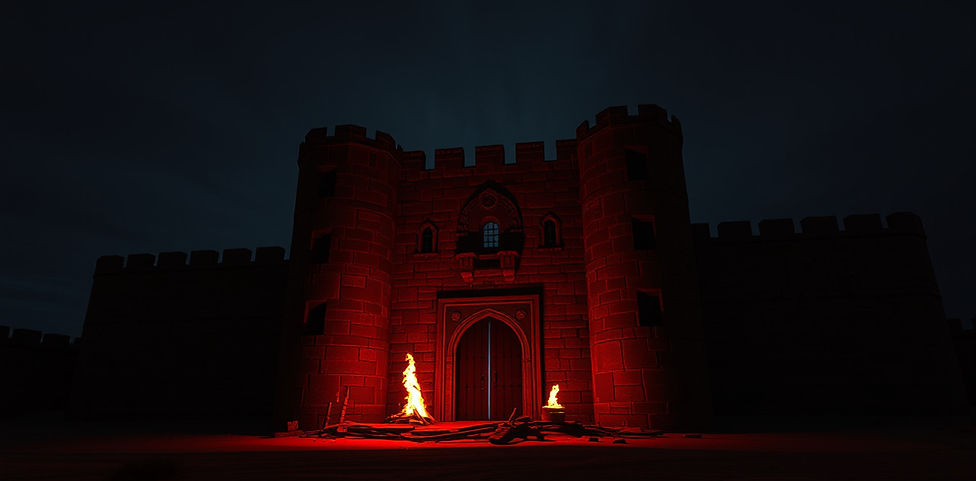
The Fist of War: A History of Deathfist Citadel
Introduction: A Fortress on a Ruined Island
On the island of Zek, in the northern reaches of a land the maps now name the Orcish Wastes, there stands a fortress that is less a building than a statement of intent. Deathfist Citadel is the seat of the Deathfist Empire, the hardened heart from which Emperor Fyst commands his armies, and from its position in northern Zek it casts a shadow of dread over any adventurer foolhardy enough to fix their gaze upon it. It is not haunted in the way a castle of the dead is haunted. Its horror is not spectral but organized, the horror of a functioning war machine, a self-sufficient society of warriors who forge their own weapons, mine their own metal, breed their own beasts, and dedicate every waking hour to the single proposition that the strong exist to destroy the weak.
To understand Deathfist Citadel, one cannot begin with its walls. One must begin with the god who made the orcs, with the long and bloody history of a people who rose from mindless savagery to tactical genius and back again, and with the island whose forests they stripped to charred stumps in service of endless war. The citadel is the current expression of an ancient and recurring pattern, the physical anchor of an empire that has risen, marched, nearly conquered the world, been shattered, and risen again more than once across the ages of Norrath. Its stones hold the philosophy of the Warlord Rallos Zek, and every orc who patrols its corridors is a small piece of a divine project that began before the continents themselves took their present shape.
This is the history of that fortress, and of the empire it commands.
The Warlord and the First Orc
The orcs are not an accident of Norrath. They were made, deliberately, by one of the very first gods to take an interest in the world. That god is Rallos Zek, the god of war and victory, known to those who revere him as the Warlord. He is the creator of the most warlike races of Norrath: the ogres, the giants, the goblins, and, most notably of all, the orcs. Rallos Zek is the personification of militant ethos, a being who cares for almost nothing outside war, conquest, and the survival of the fittest. His teaching is stark and total. His followers are taught to give no quarter and to ask none in return, and to hold as the only true rule of war the imperative to win at all costs.
The creed that flows from this god runs in the blood of every Deathfist orc. The followers of Rallos Zek believe in the survival of the strong and death to the weak. The heart of a true follower yearns for strength and courage, but above all for victory. They hold that the heat of battle is the only place and moment where enlightenment can be gained, that the universe was formed by conflict and in conflict it will end, with the victors feasting upon the remains of their fallen enemies. No respect and no regard is given to the dead, for by this logic, if the dead had been worthy their hearts would still be pumping blood through their veins rather than spilling it upon the soil. To die is simply to have proven oneself unworthy. There is a terrible internal consistency to this, and it explains a great deal about how the Deathfist treat their prisoners, their slaves, their enemies, and even one another.
There is a second god woven into the orcish story, and his tale reveals something essential about how the orcs came to be. His name is Tallon Zek, and the orcs regard him as the first orc, the supreme hero, the lord of tactics, and the giver of conquest. According to the beliefs the orcs themselves hold, it was Tallon Zek who gave a part of himself so that the supreme god of war could deliver the orc race onto the surface of Norrath. Rallos Zek deconstructed Tallon Zek and pulled from him the seeds that gave birth to the orcish people. Through visions and what some claim is genuine divine presence, Tallon Zek has since shared this knowledge with his descendants, and the orcs now raise temples to him within their empire even as they continue to honor the true art of war embodied in Rallos Zek. This is why the orcs are not merely brutal but tactical. They carry in their very origin the gift of the lord of tactics, and when they are at their most dangerous it is because they have remembered what Tallon Zek gave them.
An orc emperor, in this framework, is never simply the largest brute. He is always a hero who has survived a great many battles, invariably bearing numerous scars and often a missing limb or two, always the fiercest of the entire host. The soldiers beneath him are bred for battle from birth, fearless, and famously disciplined. They fight to the death and never sway from the order of a superior. This combination, fanatical devotion joined to genuine tactical sophistication, is what has made the orcish empires of Norrath a recurring catastrophe rather than a passing nuisance. Deathfist Citadel is the place where that combination is currently housed, fed, and directed.
The Deadtime: Savages Near Freeport
The Deathfist were not always an empire. In the earliest chapter of their recorded history, a period the orcish chroniclers themselves call the Deadtime, they were nothing more than savage beasts, one tribe among many roaming a continent far larger than any that exists today. Before the world-shaking cataclysm known as the Rending, Antonica was a vast and continuous landmass, and across it many orc tribes banded together and preyed upon whatever they could reach. One of these tribes called itself the Deathfist, and it made its home near the human city of Freeport.
In those days the Deathfist were a threat to travelers rather than to nations. They preyed upon the merchant caravans that plied the roads to the nearby fortress of Highhold, seizing goods of every kind, from foodstuffs to finely crafted weapons. Their predations drew the attention of the brigands who worked the same roads, and rather than fight over the same prey the orcs and the human bandits arrived at an unspoken understanding to stay out of one another's way, sometimes even joining forces. Working alongside their Dervish Cutthroat partners, the Deathfist grew troublesome enough that Freeport began issuing bounties for proof of their deaths. This state of low-grade war persisted for many years, and the city was never able to fully exterminate the savages at its doorstep. Little did Freeport know how much worse the problem would eventually become.
What is worth noticing about even this earliest period is that the Deathfist were already opportunists and already capable of pragmatic alliance. They were savages, yes, but savages who could recognize a useful arrangement and hold to it. The seed of the later empire, the capacity to unify disparate forces toward a shared objective, was present even when the orcs were little more than raiders in the hills. It only needed a catalyst to awaken it, and in time a catalyst would come.
The Rousing and the Rejoining: The Return of the Orcs
By the Age of Turmoil, the Deathfist had transformed from a persistent nuisance into a formidable threat to Freeport itself. Having grown in size, they absorbed the surrounding tribes one after another until they became the largest orc tribe on all of Norrath. Their swelling numbers forced the Overlord of Freeport to send armies against them from time to time, simply to keep the savages from strangling all commerce in the region. For a long while this was the shape of things, an uneasy and violent equilibrium. Then, one day, everything changed.
The turning point is remembered in a grim tale. When one of the Freeport Militia's raiding parties failed to return, search parties were sent, and when those too vanished, a full third of the Militia was dispatched to find the cause. Twelve hundred soldiers marched out. Only seventeen returned. Their account would change the way the whole world regarded the orcs. As the legion reached the last known position of the missing troops, they glimpsed several orcs fleeing into a narrow ravine and gave chase, only to find the mangled bodies of their comrades waiting inside. At that moment a wave of boulders crashed down from the surrounding cliffs, sealing off any escape, and the Deathfist released hundreds of enraged, trained war elephants that stampeded through the ravine at full speed, straight into the trapped Militia. This was not the work of mindless beasts. It was an ambush, planned and sprung with cold precision, and it announced that the orcs had become something new.
The full flowering of that transformation came when the Emperor of the Deathfist was visited by a being of immense power. This mysterious visitor prompted the Emperor to send out a call to all the minor tribes that made up the broader orcish world, and under the leadership of Emperor Gash the Deathfist began to mobilize every member of the tribe into a single great army. The call spanned an enormous reach, from the southern Rujarkian orcs to the western Kithicorian orcs, and to all of them came the same order: arm yourselves, collapse your nomadic camps, prepare for war. The stranger's message, delivered to every orcish soldier, was a single word. War.
No longer primal savages, the orcs organized into armies the likes of which Norrath had not seen for millennia. They mustered in the Desert of Ro, their ancestral homeland, and began to march. Like a plague they moved south, and they decimated everything in their path. From gypsies to desert madmen, nothing was left alive in the Desert of Ro after the orcs had crossed its dunes. They pressed on until they reached the southern Innothule swamp, and there their forces were joined to something far larger than themselves.
Fealty to the Avatar of War
In the swamp waited the Second Rallosian Empire, an army of ogres who had regained the intelligence their kind had lost in ages past. The orcs and the ogres, both children of Rallos Zek, joined into one titanic host, and the Deathfist watched as Emperor Gash bowed one knee and swore fealty to the leader of that combined army: the Avatar of War, a physical manifestation of the Warlord's own martial will. When the Avatar remarked that the Deathfist armies were larger than he had expected, Gash smiled enigmatically and told him that if this were the case, then they had already won.
That confidence was not empty bravado. Gash was a shrewd and secretive commander, and his handling of his own troops during the great march reveals the depth of orcish tactical thinking. As the combined host moved, tens of thousands of orcs were at various points swallowed whole by the desert sands, catastrophic losses that would have broken a lesser force. Yet Gash informed the Rallosians that all was not lost, for the orcs he had brought were only one half of the Empire. The other half already waited at their destination. He had divided his forces deliberately and concealed the division even from his allies, so that no ambush and no disaster could destroy the whole. When the surviving marchers finally reached their goal, they joined with the other half of the Deathfist Empire exactly as Gash had promised, and the Avatar of War began preparing his combined might for its true target: the great city of Freeport.
Here the recurring shape of orcish history becomes visible. The Deathfist are at their most dangerous not when they are angriest but when they are best organized, and their organization always seems to arrive in the wake of a visit from some being of immense power, whether the mysterious stranger who first roused Emperor Gash or the Avatar of War to whom he swore himself. The orcs supply fanaticism and numbers and tactical cunning; a divine or near-divine hand supplies unity and direction. When those two things come together, empires fall.
The War of Defiance and the Green Mist
The great assault came to be known as the War of Defiance, and for a time it seemed the orcs and ogres would achieve what no army had achieved before, the simultaneous conquest of the two largest cities on Norrath. On the northern front, the Snow Orcs and their allied giants and goblins, led by the Avatar of Flame, battered the forces of Qeynos. On the southern front, the Deathfist and their Rallosian ogre brethren laid siege to Freeport. For a while the defenders could do nothing but hold their walls and pray.
The siege of Freeport went badly for the Militia. They had not expected the combined might of the orcs and the ogres, and they did all they could simply to keep the walls standing. In time the humans realized, to their confusion, that the vast orcish and ogrish armies outside were doing nothing more than taunting them, holding position rather than pressing the attack. Then, when despair had settled onto the face of every defender and all hope seemed lost, something wholly unexpected happened. A greenish mist began to spread across the land, as far as the eye could see, filling the lungs of everyone. It seemed at first like nothing more than a strange weather phenomenon. It was nothing of the sort.
The orcs looked on in horror as every one of their ogre allies began to cough up clouds of green-colored mist. The spasms grew more and more violent until, one after another, the ogres collapsed dead from asphyxiation. In moments the entire Rallosian contingent lay dead upon the battlefield without a single visible wound, their whole army annihilated by the mysterious green mist. And as the Deathfist reeled from the sudden loss of their allies, two further armies fell upon them, intent on finishing what the mist had begun. The Freeport Militia struck from one side, the Ashen Order monks from another, and the Knights of Truth from the last. Caught on three fronts and stripped of their ogre strength, the Deathfist could not hold, though they did not go down without a fight. It took the death of the Avatar of War himself before the orcs finally broke. With their numbers reduced to mere hundreds, the remnants of the Deathfist fled past the Ashen Order toward the Desert of Ro, and there, for a time, they vanished from history.
For decades afterward the orcs were neither seen nor heard. Aside from isolated clans that had stayed out of the war, Norrath came to believe the orcish threat was gone forever. With the coming of the Rending and later the Shattering, the endless hordes faded into the stuff of stories, cautionary fairy tales about a menace that had been decisively beaten. This belief would prove to be folly, as such beliefs about the Deathfist always do.
The Sister Tribes and the Shape of Orcish War
The Deathfist did not rise alone, and their story is clarified by the parallel histories of the other great orc tribes, because those parallels reveal that the orcish pattern of savagery-into-empire was not unique to one clan but was a property of the whole race, awakened across the world at roughly the same time by the same guiding influence. Understanding the sister tribes is understanding what the Deathfist are an instance of.
The Snow Orcs made their home in the frozen wastes of Everfrost, where their only major rivals were the barbarians of Halas. Early on they were among the few orc tribes to show signs of more than animal thought, raising crude temples and performing primitive rituals to Rallos Zek, until war with the uniting barbarian clans drove them back into savagery. Their revival came through a chilling innovation. Their shamans learned to raise the bodies of the fallen, friend and foe alike, into icy-boned skeletons, and eventually learned to wield these undead minions with surprising efficiency, burying lines of skeletons beneath the snow outside a great dragon's lair and raising them all at once to trap and overwhelm heroes fleeing with stolen treasure. Like the Deathfist, the Snow Orcs were later roused by a mysterious visitor, and like the Deathfist they marched under an Avatar of the Warlord, the Avatar of Flame, until their host was swallowed whole by the very earth outside Qeynos in one of the miracles that saved that city during the War of Defiance.
The Crushbone orcs displayed a different but equally telling ingenuity. In a strange chapter of orcish history, this tribe built a great fleet of crude boats and rafts and sailed across the ocean to the continent of Faydwer, a feat of organization no one had thought such primal savages capable of. There they warred with dwarves and elves, and after early defeats they seized an abandoned outpost and used it as a base from which to launch surprisingly organized raids upon the tree city of Kelethin. In one masterstroke of misdirection they feigned assaults on the dwarven city of Kaladim and the high elven city of Felwithe, drawing off Kelethin's defenders, then struck the wood elf city itself with their true army and chopped down two of the ancient trees that supported it before they could be stopped. Here again is the signature of orcish war at its height: not brute force alone but deception, feint, and coordinated strategy, the gift of Tallon Zek expressed through a different clan.
These parallels matter because they establish that the Deathfist are not an aberration but the largest and most successful expression of a racial pattern. Every orc tribe carries the same latent capacity to rise from beasts into strategists, and every one of them, at the decisive moment, was touched by the same kind of powerful visitor bearing the same command. When the Deathfist built their empire on Zek, they were not doing something new. They were doing, on the grandest scale, what the whole orcish race is built by its god to do.
The Clefts and the Industry of War
The Deathfist role as the arsenal of a wider orcish power is illuminated by the Clefts of Rujark, the bastion of their Rujarkian overlords far to the south in the Sinking Sands, reached by traveling down the old Orc Highway. The Clefts are a vast network of canyons and tunnels where orcs mine mineral deposits from bands of compressed sand and stone and carry the ore from raw state to finished product without ever leaving the area, a self-contained industrial complex much like the citadel itself. What is telling is the material evidence of the link between the two orcish strongholds. The heavy wooden doors that barricade the entrances to the Clefts, and the scaffolding that provides access to their higher levels, are made of timber judged by its thickness and quality to have been imported from Zek. The Deathfist strip the Jaggedpine, and the fine, thick lumber of that dying forest travels south to armor the tunnels of Rujark. At the highest levels of the Clefts one encounters orcs bearing both Deathfist and Crushbone markings, mingling in the service of the shared empire. The ruin of Zek's forest, in other words, is not a local tragedy but a supply line, one strand in a web of orcish industry that spans the wastes of Norrath, with Deathfist Citadel as one of its central looms.
The Claiming of Zek
The world that emerged from the great cataclysms was a broken one, its once-continuous continents sundered into scattered islands and isolated lands. Amid this reshaping, the orcs did something that set the stage for everything that Deathfist Citadel would become. They did not merely reappear. They took a homeland.
The land that had been the Jaggedpine Forest, a place not devastated by the natural cataclysms that reshaped so much of the world, was instead claimed and ruined by orcs, who staked their possession of it and gave it a new identity. The survivors of the old world came to call it the Orcish Wastes, or simply Zek, after the Warlord's own name. It lies to the north of Karan, across the Coldwind Coast and over the Sea of Crossed Swords, relatively close to the Antonican shores though separated from them by deep and treacherous waters. It is not a large landmass, and its barren slopes offer little windbreak, so that even a gentle breeze can build into a hearty windstorm as it channels through the hills. With little shade, the surface reflects the sunlight back and keeps the region warm, while the deep mines below stay cool.
The transformation the Deathfist worked upon this land is itself a kind of monument to their creed. They cleared most of the area, leaving only stumps and deadwood as evidence that the Jaggedpine Forest had ever existed. Where pockets of trees remained, they were thin and scraggly; where grass grew, it was trampled and flattened; and no flowering plants were known to grow there at all. The guards stationed at the region's outposts liked to say that one could not throw a copper without hitting an orc. This is what the Deathfist do to a place. They do not simply occupy it. They consume it, stripping the forest to feed their forges and their shipyards, gutting the earth below for its ore, and leaving behind a wasteland that serves the single purpose of making war. The ruin of the Jaggedpine is not incidental to the empire. It is the empire's nature made visible across an entire island.
The Empire and Its Machinery
By the Age of Destiny, Deathfist Citadel stood as the main fortress and seat of power of a functioning empire, and it is worth dwelling on just how organized that empire is, because its organization is what distinguishes it from a mere warren of monsters. The Deathfist orcs fall under the broader Rujarkian power structure, yet they operate as a stand-alone entity with their own sphere of influence and control. Their labor is unceasing and purposeful: they work tirelessly to ship arms and resources from the island of Zek to the other orc clans of the Rujarkian Empire, functioning as a kind of arsenal and supply depot for a wider orcish war effort. The Rujarkian Empire, near the end of the Age of Cataclysms and into the beginning of the Age of Destiny, was one of the greatest naval superpowers Norrath had known, and the Deathfist were its industrial engine.
A visitor to the citadel can read the empire's character in its very furnishings. Everything about the place speaks of a self-sufficient society rather than a mindless mob. There is a forge within its walls, the Blood Iron forge, where the orcs work Blood Iron ore into finished arms and armor, the whole cycle of extraction and manufacture contained within their own stronghold. There are quarters and kitchens and workspaces. There are specialists: alchemists, priests of Zek who heal their fellows in battle, gate keepers, taskmistresses driving slaves at their labor. There are champions and gladiators. The dungeon is not a linear corridor of identical brutes but a cross-section of a working military state, with an economy, a religion, a hierarchy, and a purpose. The Deathfist are, in the words of those who have studied them, much more capable than any band of mindless undead, and the citadel is built to reflect an organized society at war.
At the apex of this hierarchy sits the emperor, and in the era when adventurers first breach the citadel in force, that emperor is Fyst. From the citadel Emperor Fyst commands numerous orc armies, the fiercest warrior of a people who prize ferocity above all. His seat of power includes the Blood Bath Arena, a place whose name requires no explanation, where champions like Arena Champion Kraz'k and the Emperor's chosen gladiators prove their worth in blood before a roaring crowd. To reach Fyst, an intruder must fight through the whole apparatus of his rule, defeating his elite VIPs and his champions and his beasts, a gauntlet that is itself a demonstration of how much machinery stands between the outside world and the orcish throne. The arena is the citadel in miniature: a place where the creed of Rallos Zek, that only the victor deserves to live, is enacted as public spectacle, again and again, for the entertainment and instruction of an entire warrior society.
The Green Hoods and the Far Seas
An empire defined by conquest naturally breeds enemies, and Deathfist Citadel does not stand unopposed on its ruined island. Two forces in particular press against it, and their struggle gives the citadel's story its immediate stakes.
The first is the Green Hoods, a band of woodland defenders who guard what little of Zek's landscape has remained lush and green amid the orcish devastation. The Deathfist stripping of the forest, their reduction of the Jaggedpine to barren and charred earth, caught the attention of these defenders, who found themselves locked in a constant struggle against the unified orcs. During the Age of Destiny the ranks of the Green Hoods surged, and for the first time they gained the manpower to begin striking back at the Deathfist Empire in earnest. Theirs is a fight not merely for territory but for the living world itself against a power that treats forests as fuel and land as a resource to be exhausted.
The second force is the Far Seas Trading Company, whose interest in Zek is commercial and strategic. As the great cities of Norrath slowly recovered their strength, the shipping lanes that the orcs and their sea-going pirates had long plagued began to reopen with the Far Seas Trading Company's help. In time Freeport and Qeynos regained enough power to push back against the orcs upon the open seas, and eventually onto the isle of Zek itself, establishing footholds and fortifications from which to contest orcish dominance. The Far Seas presence on Zek, near the docks, represents the encroachment of the civilized world onto the empire's home ground, and the orcs regard it as an intolerable threat.
It is against this backdrop that the citadel's most dangerous scheme takes shape. Having been weakened considerably by adventurers striking out from Freeport and Qeynos, the Deathfist recently recruited someone to help them empower a terrible siege weapon known as the Arm of Innoruuk. Once that enchanted weapon is complete, the orcs intend to obliterate the Far Seas Trading Company's foothold upon Zek, and after that to turn the weapon against the cities of Freeport and Qeynos themselves. The Arm of Innoruuk is the empire's bid to reverse its recent losses in a single devastating stroke, and it ties the Deathfist to darker powers still, for Innoruuk is the god of hate and a known ally of Rallos Zek. The completion of that weapon is precisely the sort of catalyst that has, throughout orcish history, turned a weakened tribe back into a world-threatening empire. It is the reason the citadel must be breached and its emperor thrown down, before the pattern can complete itself yet again.
The Death of Fyst and the Rise of the Scourge
The empires of the Deathfist have always risen and fallen in cycles, and the reign of Emperor Fyst was no exception. His end came not from the great cities' armies but from the woodland defenders he had spent so long fighting. Green Hood recruits, striking into the very heart of orcish power, succeeded in murdering Emperor Fyst along with his strongest champions. For a moment it might have seemed that the endless machine of the Deathfist had finally been broken at its head.
But a fortress built on the creed of Rallos Zek does not stay leaderless for long, because that creed guarantees that the strongest survivor will simply seize the vacant throne. In the wake of Fyst's death, a new warlord arose to claim the crown of the Deathfist Emperor. Under the reign of the orc called Blacktusk, a group known as the Heralds of Zek rose to prominence, and the character of the empire began to shift toward something even more overtly religious and militant. Those Heralds would in time become the Sanctifiers of War of a new and more terrible breed of orc.
For the island itself, the change was catastrophic in a new way. Zek came to be overrun by a new race of orc, born of the power and hubris of Tallon and Vallon Zek, the sons of the Warlord. The few remaining pockets of ancient forest flora and fauna were decimated, and the Orcish Wastes gave way to something even more blasted, remembered as the Scourge Wastes. The danger these new orcs represent is not merely military but cosmic. Should the Plane of War be allowed to forge a physical connection to Norrath, the march of War itself could become unstoppable, a permanent bleeding of the Warlord's own realm into the mortal world. The story that began with Rallos Zek deconstructing Tallon Zek to seed the orc race thus circles back toward its source, as the descendants of that first sacrifice reach again toward the divine power that made them.
This is the deepest truth of Deathfist Citadel. It is not a single fortress with a single fall, but a recurring node in an ancient and cyclical war. The Deathfist have been savage raiders near Freeport, a disciplined empire that nearly toppled the two greatest cities of Norrath, a shattered remnant fleeing into the desert, an industrial war-state gutting an entire island, and at last the cradle of a Scourge born half of the Plane of War itself. Each time they are broken, the creed of Rallos Zek ensures that a new strongest one rises to rebuild what was lost, and each time some being of immense power arrives to supply the unity that turns a tribe back into an empire.
Conclusion: The Anvil of the Warlord
To stand before Deathfist Citadel is to stand before a working expression of a single, terrible idea, the idea that conflict is the fundamental substance of existence and that only the victor has earned the right to go on living. Everything about the fortress serves that idea. Its forge turns raw Blood Iron into weapons. Its arena turns life into spectacle and death into instruction. Its mines and its stripped forests turn a whole island into fuel for war. Its hierarchy of scarred emperors and bred-for-battle soldiers turns the philosophy of Rallos Zek into a living institution that has outlasted cataclysms which reshaped the very continents.
What makes the citadel genuinely frightening is not that its orcs are strong, though they are, and not that they are numerous, though they are that too. It is that they are organized, that behind their ferocity lies the tactical inheritance of Tallon Zek and behind their unity lies the guiding hand of the Warlord and his avatars. Norrath has learned, again and again and at enormous cost, that the orcs are most dangerous precisely when the wider world has decided they are beaten. The Militia that sent twelve hundred soldiers into a ravine and got seventeen back learned it. The ogres who marched to Freeport as allies and drowned in green mist learned it. The generations who believed the orcs had faded into fairy tales after the War of Defiance learned it. And the Green Hoods who murdered Emperor Fyst, only to watch a new and worse warlord take his crown, learned it as well.
Deathfist Citadel endures because the idea it houses endures. So long as there is a Warlord who teaches that the universe was born in conflict and will end in conflict, there will be orcs to believe it, and so long as there are orcs to believe it, there will be a fortress somewhere on the wastes of Zek where the strongest of them sits upon a bloody throne and dreams of the march that will finally bring the world to heel. The citadel is the anvil upon which Rallos Zek hammers his endless war, and the hammer has not yet stopped falling.
